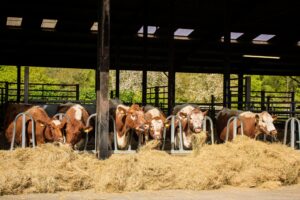
- The calf stays in an individual house for the first month,
- then moves to a large group with individual and group feeders.
The premises are designed with seasonality in mind:
- in the spring - covered,
- dry and well-ventilated in summer,
- in winter - without high humidity and with heating.
This is fundamentally different from approaches where calves are kept outdoors, which negatively affects growth and feed intake, especially in difficult weather conditions.
Holstein breed as a strategic choice
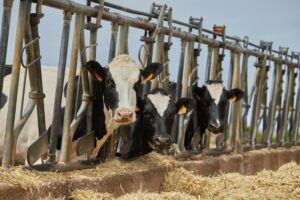
Terezyne Farm is one of the first farms in Ukraine to work exclusively with the Holstein breed.
Five years ago, the farm kept three breeds:
- Ukrainian black-and-white dairy,
- Ukrainian red-and-white dairy,
- Holstein.
However, due to the limited availability of high-quality genetics and economic calculations, it was decided to keep one breed, the Holstein, as the most promising in terms of productivity and payback.
Reconstructions and untethered detention
Since 2003, all reconstructions on the farm have been aimed at improving the comfort of the animals. The last large-scale renovations took place three years ago:
- the roof and panels were replaced,
- modern fans are installed,
- a system of curtains that open in summer was introduced.
As a result, the premises are warmer and more stable in temperature in winter than old fully enclosed buildings, and closer to open space conditions in summer.
SenseHub and herd health management
The farm has implemented the SenseHub system, which tracks everything:
- cow activity,
- health status,
- the process of chewing.
This allows us not only to accurately determine the optimal time for insemination, but also to take a comprehensive approach to herd management.
Two months before calving, cows go through a «start-up» period:
- first month - rest after lactation,
- The second is preparation for calving.
In total, the farm has about 4,500 cattle, of which about 1,200 are in breeding.
Selection of bulls and feeding system
The farm works with the market and attracts the best bulls based on clear evaluation criteria. The farm cooperates with several companies, including Ukrainian suppliers.
The feeding system has also been modernized. A 22-cubic meter mixer is used, which is controlled by one operator. The feed is prepared in stages:
- First, the base mixture,
- then adding components depending on the animal group.
This greatly simplifies the process and increases the accuracy of the rations.
Milking parlors, robotics and ergonomics
The milking parlor was built in 2003 and was one of the first in Ukraine for DeLaval. Today it serves:
- 32 animals at the same time,
- works up to 16 hours a day.
The farm has also introduced robotic milking systems. Although the robot is more expensive, it:
- serves up to 60 cows,
- has a higher bandwidth,
- reduces the workload on staff.
Biogas and waste utilization
The biogas plant was built in the 2000s and is currently undergoing reconstruction. In the future, it should:
- provide energy to the farm and the surrounding village,
- make the farm energy independent.
Livestock waste is processed into fertilizers, which are transported directly to the fields via a 4 km long pipeline and used in the next season.
The challenges of war and a look to the future
The start of the full-scale invasion was a serious challenge:
- logistics stoppage,
- panic,
- the need to reduce milk yields and start cows.
However, the farm has retained its production and team. The owners are convinced that the future of the Ukrainian dairy business lies in domestic development, preservation of genetic potential, creation of new farms, jobs and a full processing cycle.